Our first book
Turkish Slavery
A Flemish Captive in Algiers, 1640–1642
Emanuel d’Aranda · translated from the Dutch Turckse slavernie (The Hague, 1666)
Paperback · coming soon on Amazon
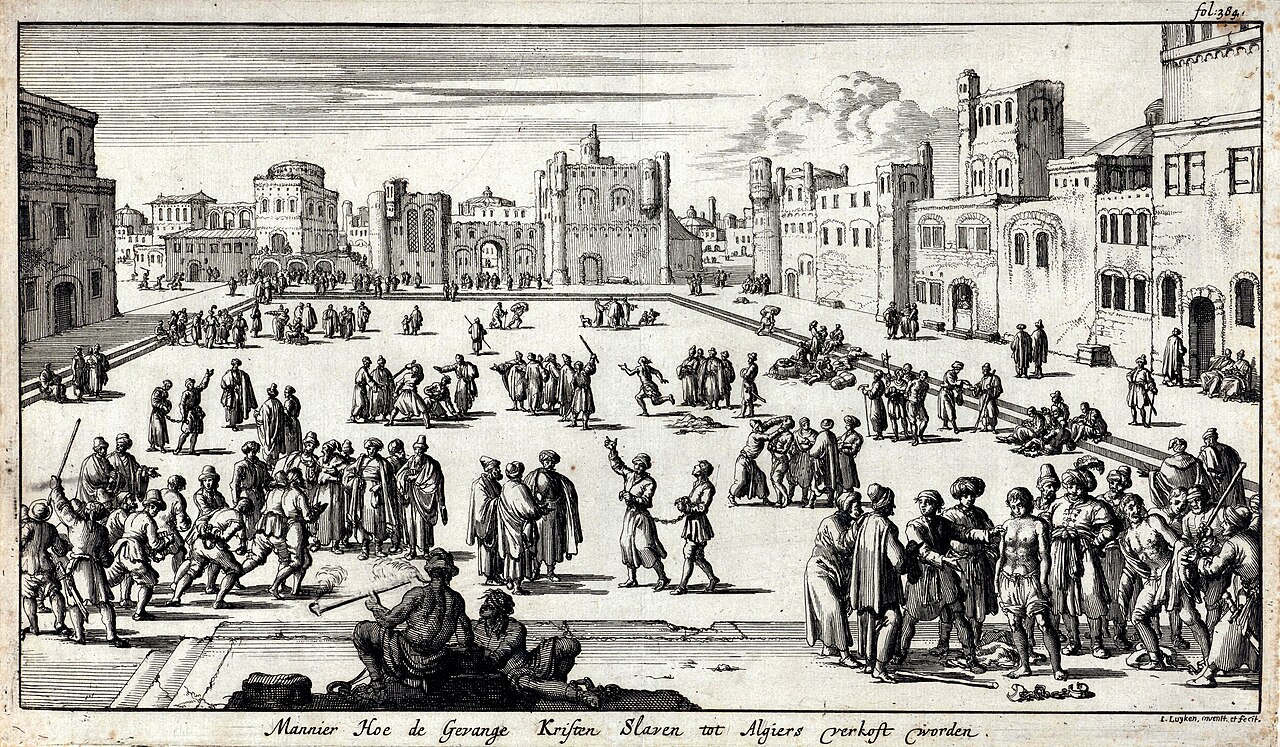
In August 1640 a gentleman from Bruges set out from Madrid to return home to the Netherlands. Off the coast of Brittany his English ship was taken by corsairs from Algiers. He was sold in the slave market of Algiers and remained a captive there until his release in March 1642.
His book is no outrage pamphlet and no adventure novel. D’Aranda calls it “a plain and truthful account”: a sharp-eyed record of the bagnio, the market, the work, the people he met — masters and fellow slaves, renegades and merchants — told with personal feeling, moral reflection and a surprising amount of curiosity.
A taste of the text
Off the coast of Brittany, after a night spent watching a strange caravel keep them in sight, a lantern at her stern, the passengers see two larger ships coming down on them:
About ten in the forenoon the two ships joined the caravel, all still without a flag. Then in a moment they gained the wind of us under full sail, a musket-shot off. On the stern of the largest ship stood a Turk with a furled flag in his arms, and a Christian slave, who cried, Strike for Algiers. At that cry the man who held the flag let it fly. It was green, with silver crescents upon it. How welcome that flag was to us, and the sight of our being carried to Algiers, may easily be imagined.
The author and his captivity
Emanuel d’Aranda came from a family of Spanish origin settled in Bruges. After a year in Spain he left Madrid on 1 August 1640 with a countryman, Reynier Saldens, and at San Sebastián took ship for home with two more friends. On 22 August their English merchantman was taken in the Bay of Biscay, off Brittany, by Algerian corsairs; one of the corsair captains was an English renegade.
In Algiers the captives were brought before the Pasha, who was entitled to one in every eight new slaves, and then sold in the market. D’Aranda was bought by Ali Pegelin and lodged in his bagnio, the slave prison where captives slept and from which they were sent out to work.
What followed was the slow business of losgeld, ransom. The captives had given false names to avoid being taken for rich men, which made negotiations harder. In the end d’Aranda was exchanged for Muslim captives held in Dunkirk; the exchange took place at Ceuta, and on 24 March 1642 he crossed to Gibraltar, a free man. He reached Bruges that August.
He first published his account in French at Brussels in 1656. The Dutch edition of 1666, from which we translate, contains the main narrative followed by thirty-seven shorter accounts of things he saw and heard in captivity. It was reprinted several times in his lifetime and also appeared in England and France.
About this translation
The translation is made with the help of AI, within a strict framework of rules set by the editor and applied throughout the book. The editor checks every page against the original Dutch edition, for historical and nautical accuracy as well, and edits it with creative and stylistic freedom until it reads as clear modern English, with nothing added and nothing softened.
The translation is made directly from the 1666 Dutch text (Project Gutenberg eBook 69645, a transcription of that edition), not from the English version printed in London in the same century. Numbers, names and dates are kept exactly as printed. Historical place names are kept, with a brief note where a modern reader needs one.
The translation is complete. Publication date, price and ISBN will be announced here as soon as the book is on sale.